Qu'est-ce que la détection et la réponse gérées (MDR) ? Guide complet
Aperçu de la situation
Grâce à une surveillance continue et à l'expertise humaine, le MDR réduit le délai moyen de détection des menaces de 277 jours à quelques minutes (rapport IBM sur le coût des violations de données, 2024).
Le MDR se distingue fondamentalement de l'EDR (simple outil) et du XDR (plateforme) en proposant des services spécialisés entièrement gérés, disponibles 24 heures sur 24 et 7 jours sur 7, dotés de capacités de réponse complètes.
Les exigences de conformité à la directive NIS 2 entraînent une hausse de 40 % du taux d'adoption du règlement MDR en Europe, tandis que des pressions réglementaires similaires se font sentir à l'échelle mondiale (Gartner, 2025).
Les équipes de sécurité sont confrontées à un dilemme insoluble : se défendre contre deshackers et aux opérateurs de ransomware qui opèrent 24 heures sur 24, 7 jours sur 7, tout en étant confrontées à des ressources limitées, à la fatigue liée aux alertes et à une pénurie persistante de talents. Alors qu’une violation de données coûte désormais en moyenne 4,45 millions de dollars aux entreprises et que les attaques par ransomware ont augmenté de 41 % d’un mois à l’autre fin 2025, l’approche traditionnelle consistant à s’appuyer uniquement sur des outils de sécurité a atteint ses limites (IBM, 2024 ; SonicWall, 2025).
La détection et la réponse gérées (MDR) constituent un service de sécurité en pleine expansion qui transforme en profondeur la manière dont les entreprises abordent la détection et la réponse aux menaces. La croissance explosive du marché du MDR, qui devrait atteindre 11,8 milliards de dollars d'ici 2030 avec un taux de croissance annuel composé de 21,9 %, reflète un changement majeur : les organisations passent de stratégies de sécurité centrées sur les outils à des stratégies centrées sur les services, reconnaissant que la technologie seule ne peut pas suivre le rythme des menaces modernes (MarketsandMarkets, 2024).
Ce guide explique ce qu’est le MDR, comment il fonctionne, ce qui le distingue d’autres solutions telles que l’EDR, le XDR et les MSSP, et comment choisir l’approche la mieux adaptée à votre organisation. Que vous soyez un RSSI évaluant le MDR pour la première fois, un analyste SOC comparant différents fournisseurs ou un responsable de la sécurité élaborant une analyse de rentabilité, cette page aborde les aspects opérationnels, techniques et stratégiques de la détection et de la réponse gérées.
Qu'est-ce que la détection et la réponse gérées (MDR) ?
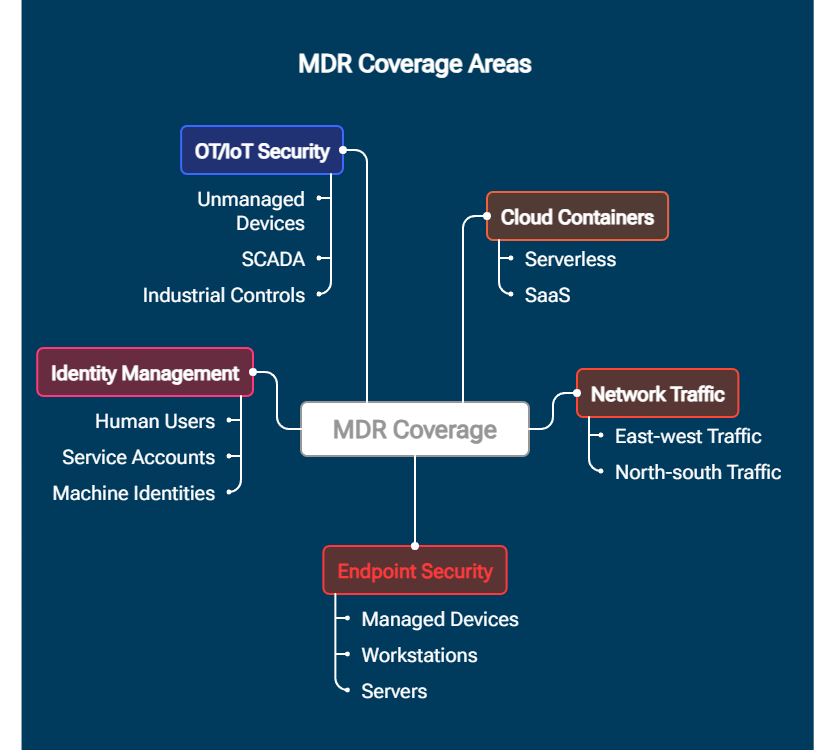
La détection et la réponse gérées (MDR) est un service de cybersécurité qui associe technologies de sécurité, renseignements sur les menaces, recherche active de menaces et expertise humaine afin d'assurer une surveillance, une détection, une analyse et une réponse aux menaces 24 heures sur 24, 7 jours sur 7. Les fournisseurs de services MDR aident les entreprises à identifier et à contrer les cyberattaques en analysant en permanence les données de télémétrie de sécurité provenant des terminaux, des identités, des réseaux, cloud et des applications SaaS.
Pourquoi les entreprises ont-elles besoin d'un MDR ?
Le déficit de compétences en matière de cybersécurité, l'accélération des délais d'attaque et le renforcement des exigences de conformité ont rendu le MDR indispensable pour les organisations qui ne sont pas en mesure d'assurer en interne des opérations de sécurité 24 heures sur 24, 7 jours sur 7. Le MDR permet de pallier les limites structurelles qu'aucun outil ou plateforme résoudre à lui seul.
Les équipes de sécurité sont débordées. Le déficit mondial en main-d'œuvre s'élève à 3,5 millions de postes vacants dans le domaine de la cybersécurité (ISC2, 2024). Même les organisations disposant d'équipes SOC internes sont confrontées à des lacunes de couverture pendant la nuit, les week-ends et les jours fériés, soit précisément aux moments où 88 % des attaques par ransomware ont lieu (Sophos Active Adversary Report, 2025).
Les pirates agissent plus vite que ne le permettent les processus manuels. Le délai moyen de détection des cybercrimes est tombé à 29 minutes (Rapport mondial sur les menaces de CrowdStrike, 2026). Les attaques basées sur l'IA raccourcissent encore davantage ces délais :
L'IA générative accélère la reconnaissance et l'ingénierie sociale à grande échelle
Les kits d'outils automatisés permettent d'accélérer la propagation latérale et l'escalade des privilèges
Les charges utiles générées par l'IA s'adaptent en temps réel pour contourner les défenses statiques
Les exigences en matière de conformité et d'assurance imposent désormais une couverture 24 heures sur 24, 7 jours sur 7. Le MDR assure la continuité des opérations, les enquêtes menées par des experts et les processus documentés que ces cadres réglementaires exigent :
La directive NIS2 impose un délai de préavis de 24 heures et une notification des incidents dans les 72 heures pour l'ensemble des infrastructures critiques
Les assureurs cyber exigent de plus en plus souvent que la surveillance et les mesures d'intervention soient documentées pour accorder leur couverture
Éléments clés du MDR
La détection et la réponse gérées (MDR) est un service complet de cybersécurité qui combine une technologie de sécurité avancée et l'expertise humaine pour fournir aux organisations des capacités de surveillance, de détection, d'investigation et de réponse aux menaces 24 heures sur 24, 7 jours sur 7. Contrairement aux outils de sécurité traditionnels qui nécessitent l'intervention et l'interprétation d'équipes internes, le MDR fournit des résultats en matière de sécurité sous la forme d'un service entièrement géré, ce qui change fondamentalement la manière dont les organisations se protègent contre les menaces modernes.
L'efficacité de MDR repose sur cinq éléments essentiels qui, combinés, assurent une couverture de sécurité complète.
Hiérarchisation et alertes : grâce à des analyses avancées , les menaces les plus critiques sont mises en évidence parmi les milliers d'événements de sécurité quotidiens. Plutôt que de submerger les équipes d'informations superflues, les services MDR concentrent leur attention sur les menaces réelles nécessitant une intervention immédiate.
Chasse aux menaces : les experts en sécurité recherchent activement les menaces cachées que les outils automatisés pourraient ne pas détecter. Hunters les renseignements sur les menaces, l'analyse comportementale et leurs années d'expérience pour identifier les attaquants sophistiqués qui ont réussi à contourner les premières couches de détection. De nombreux fournisseurs de services MDR alignent leurs activités de chasse aux menaces sur le MITRE ATT&CK , aidant ainsi les analystes à identifier les tactiques, techniques et procédures (TTP) des attaquants tout au long du cycle de vie de l'attaque.
Renseignements sur les menaces: les services MDR enrichissent les détections grâce à des renseignements sur les adversaires, les indicateurs de compromission (IOC), les nouvelles techniques d'attaque et les menaces spécifiques à chaque secteur. Ce contexte aide les analystes à hiérarchiser les enquêtes, à accélérer la réponse et à identifier les menaces susceptibles de contourner les contrôles de sécurité traditionnels.
Enquête : une analyse approfondie , menée dès la détection d'une menace, permet de déterminer l'étendue, l'impact et la cause profonde de celle-ci. Cette enquête approfondie va au-delà de la simple validation des alertes et offre aux organisations une compréhension complète des chaînes d'attaque et des tactiques des attaquants.
Réponse guidée et mesures correctives : des mesures correctives spécifiques et concrètes, adaptées à chaque scénario de menace. Les services MDR fournissent des conseils ciblés plutôt que des recommandations génériques, et l'assistance à la correction s'attaque aux vulnérabilités sous-jacentes afin de prévenir de futures attaques.
Intégration continue : les composants MDR s'intègrent de manière transparente aux flux de travail existants du centre des opérations de sécurité, renforçant ainsi les investissements actuels en matière de sécurité plutôt que de les remplacer. Il en résulte un effet multiplicateur qui améliore considérablement le niveau de sécurité sans nécessiter une expansion massive des équipes internes.
La plupart des outils MDR s'intègrent aux technologies endpoint et de réponse endpoint (EDR), de gestion des informations et des événements de sécurité (SIEM), cloud , de protection des identités et de détection des menaces réseau afin d'offrir une visibilité complète sur l'ensemble de la surface d'attaque.
Comment fonctionne le MDR ?
Les services MDR s'appuient sur un processus opérationnel à la fois sophistiqué et rationalisé, conçu pour optimiser à la fois la rapidité et la précision de la détection des menaces et de la réponse. Comprendre ce flux de travail permet aux entreprises de saisir la valeur ajoutée que le MDR apporte par rapport aux outils de sécurité traditionnels, et de comprendre pourquoi son déploiement peut transformer les opérations de sécurité en quelques jours plutôt qu'en plusieurs mois.
Le processus de travail MDR
Le processus MDR, tel que défini par des leaders du secteur tels que Microsoft et CrowdStrike, propose une approche structurée de la gestion des menaces en cinq étapes intégrées.
La première étape consiste à collecter en continu des données provenant de l'ensemble de l'environnement, afin d'établir une base de référence complète en matière de télémétrie de sécurité. Il s'agit d'une collecte active et intelligente de données pertinentes pour la sécurité, optimisée pour la détection des menaces sur les terminaux, le trafic réseau, cloud , les systèmes d'identité et les applications SaaS.
La deuxième étape exploite la détection automatisée des menaces pour identifier les incidents de sécurité potentiels parmi le volume massif d'événements quotidiens. Des moteurs de corrélation avancés relient des activités apparemment sans rapport entre elles afin de révéler des chaînes d'attaques, tandis que des modèles d'apprentissage automatique identifient les nouvelles menaces sans s'appuyer sur des signatures connues.
De nombreuses entreprises évaluent conjointement les plateformes MDR et les plateformes XDR, car toutes deux offrent une visibilité centralisée et des capacités de détection. La principale différence réside dans le fait que le MDR associe la technologie à des analystes experts qui surveillent, examinent et réagissent en permanence aux menaces.
L'intervention humaine à la troisième étape apporte un contexte et une expertise essentiels que la technologie seule ne peut fournir. Les analystes en sécurité mènent des investigations afin de déterminer si les alertes correspondent à de véritables menaces ou à de faux positifs. Cette validation humaine réduit considérablement la fatigue liée aux alertes tout en garantissant que les menaces réelles bénéficient d'une attention immédiate.
Les recommandations d'intervention de la quatrième étape fournissent aux organisations des mesures claires et hiérarchisées pour faire face aux menaces confirmées. Plutôt que de se contenter de conseils généraux, les services MDR proposent des mesures correctives spécifiques, adaptées à l'environnement de l'organisation et à la menace détectée. La cinquième étape va au-delà de la réponse immédiate pour inclure un accompagnement à la remédiation, aidant ainsi les organisations à s'attaquer aux causes profondes et à prévenir des attaques similaires à l'avenir.
Détection multi-domaines
Les services MDR modernes déploient des capacités de détection dans plusieurs domaines de sécurité afin d'assurer une couverture complète contre les menaces.
L'analyse du trafic réseau permet d'identifier les communications de commande et de contrôle, les tentatives d'exfiltration de données et les mouvements latéraux entre les systèmes. La détection réseau avancée va au-delà de la simple comparaison de signatures pour inclure l'analyse du trafic chiffré, la détection des anomalies de protocole et l'identification des menaces basée sur l'apprentissage automatique.
Ces fonctionnalités sont généralement fournies par des plateformesdétection et réponse aux incidents NDR), qui analysent le comportement du réseau afin d'identifier les mouvements latéraux, les communications de commande et de contrôle, ainsi que l'exfiltration de données que les outils endpoint pourraient ne pas détecter.
La surveillanceEndpoint offre une visibilité détaillée sur l'exécution des processus, les modifications du système de fichiers, les modifications du registre et les attaques visant la mémoire. La surveillance Endpoint offre une visibilité sur l'activité des processus, les modifications de fichiers et les menaces visant la mémoire.
Les systèmes de détection modernes vont au-delà des antivirus en identifiant les comportements suspects, même en l'absence de signatures connues. Cela est essentiel pour contrer des attaques telles que le « SEO poisoning », où des résultats de recherche manipulés diffusent malware des domaines nouveaux ou d'apparence fiable qui échappent aux outils basés sur les signatures.
La détection des menaces liées à l'identité est devenue cruciale, les attaquants ayant désormais pour cible les identifiants plutôt que l'infrastructure. Les services MDR surveillent les schémas d'authentification, l'utilisation des privilèges et le comportement des comptes afin d'identifierUsurpation de compte et les menaces internes.
La détection de techniques telles que Kerberoasting, le « password spraying » et les attaques par « golden ticket » empêche les pirates d'obtenir un accès persistant via des identités compromises.
La protectionCloud répond aux défis liés à la sécurisation cloud dynamiques. Les services MDR surveillent les modifications cloud , l'utilisation des API et les modèles d'accès aux ressources afin d'identifier les erreurs de configuration et les attaques en cours au sein des conteneurs, des fonctions sans serveur et des offres plateforme.
L'IA et l'automatisation dans le MDR moderne
L'intelligence artificielle et l'automatisation ont révolutionné les capacités des solutions MDR, donnant naissance à des services MDR basés sur l'IA (AI MDR) qui associent apprentissage automatique, analyse comportementale, automatisation et expertise humaine afin d'accélérer la détection des menaces et la réaction face à celles-ci.
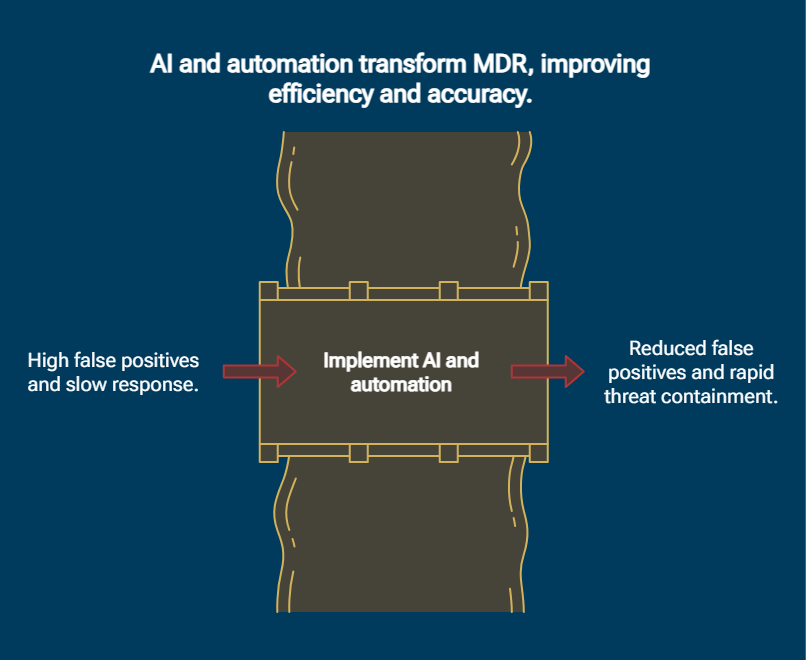
Les plateformes MDR modernes parviennent à réduire de 85 % les faux positifs grâce à des modèles d'apprentissage automatique entraînés sur des millions d'incidents de sécurité (Vectra AI, 2025). Ces modèles s'améliorent en permanence grâce à des boucles de rétroaction, ce qui leur permet de distinguer avec toujours plus de précision les menaces réelles des anomalies bénignes.
Les analystes virtuels, alimentés par l'IA générative, sont désormais capables de mener des enquêtes préliminaires, de recueillir des informations contextuelles et de rédiger des rapports d'incident destinés à être examinés par des humains. La sécurité prédictive en temps réel analyse les tendances dans des milliers d'environnements clients et déploie immédiatement des mesures de protection dès qu'une nouvelle technique d'attaque est détectée chez un client.
L'automatisation s'étend également aux mesures de réponse. Des scénarios pré-approuvés permettent de contenir immédiatement les menaces confirmées, par exemple en isolant les terminaux compromis ou en désactivant les comptes compromis. Cette capacité de réponse autonome est cruciale face aux ransomwares ou à l'exfiltration de données, où chaque seconde compte. Toutefois, la supervision humaine reste indispensable pour les décisions complexes et les situations nécessitant une prise en compte du contexte métier.
Le lancement par CrowdStrike de la solution Agentic MDR en mars 2026 marque une nouvelle étape : des agents intelligents qui automatisent les processus de sécurité fastidieux, tandis que des analystes humains hautement qualifiés se concentrent sur la lutte contre les attaquants et la mise en place de réponses stratégiques. Les entreprises qui envisagent d'adopter une solution MDR doivent évaluer dans quelle mesure les fournisseurs parviennent à concilier la rapidité de l'automatisation et le jugement humain tout au long du cycle de détection et de réponse.
MDR contre les ransomwares
Les ransomwares constituent l'une des preuves les plus évidentes de la valeur opérationnelle du MDR. Les attaques modernes par ransomware ne commencent pas par le chiffrement, mais par une phase de reconnaissance, d’un mouvement latéral et d’une élévation de privilèges pouvant durer des semaines, voire des mois, en suivant chaque étape de lachaîne de destruction cybernétique avant que la charge utile finale ne soit déployée. Les services MDR détectent ces activités précurseurs grâce à l'analyse comportementale, en identifiant les schémas d'accès aux fichiers inhabituels, les exécutions de processus anormales et les communications réseau suspectes qui indiquent la préparation d'un ransomware.
La surveillance 24 heures sur 24, 7 jours sur 7, offerte par le MDR s'avère particulièrement importante, étant donné que 88 % des attaques se produisent en dehors des heures de bureau habituelles. Les pirates choisissent délibérément de mener leurs opérations la nuit, le week-end et pendant les jours fériés, lorsque les équipes de sécurité sont réduites au minimum ou absentes. Les services MDR maintiennent une vigilance constante, quelle que soit l'heure, garantissant ainsi que les menaces sont détectées et maîtrisées avant que des dommages importants ne surviennent (Rapport Sophos sur les adversaires actifs, 2025).
Le service MDR d'une entreprise manufacturière a détecté une activité PowerShell inhabituelle à 2 heures du matin un samedi. L'équipe MDR a immédiatement mené une enquête, identifié une variante du ransomware Qlin qui s'apprêtait à chiffrer les systèmes, et maîtrisé l'attaque avant que les données ne soient chiffrées. Sans une couverture MDR 24 heures sur 24, 7 jours sur 7, l'attaque aurait abouti, ce qui aurait pu entraîner des coûts de plusieurs millions d'euros en temps d'arrêt et en frais de restauration.
MDR dans les environnements cloud, réseau et OT
Le MDR a évolué au-delà endpoint la endpoint protection endpoint pour couvrir l'ensemble des environnements d'entreprise modernes. Alors que les organisations opèrent à la fois sur cloud , des réseaux distribués et des systèmes de technologie opérationnelle, les services MDR doivent offrir des capacités de détection et de réponse spécifiques à chaque domaine, tenant compte des caractéristiques propres à chaque environnement.
MDR Cloud
Les solutions MDR Cloud répondent aux défis spécifiques liés à la protection des entreprises cloud. Ces services s'appuient sur des outils de sécurité et des API cloud pour offrir une visibilité approfondie sur cloud , les conteneurs et les fonctions sans serveur. Contrairement aux solutions MDR traditionnelles, qui adaptent des outils sur site à cloud , les solutions MDR cloud sont conçues dès le départ pour cloud ; elles surveillent les modifications de configuration, l'utilisation des API et les modèles d'accès aux ressources afin d'identifier les erreurs de configuration et les attaques en cours.
MDR en réseau
Le MDR basé sur le réseau se concentre sur l'analyse des flux de trafic, des schémas comportementaux et des voies de communication au sein du réseau d'entreprise. En déployant des capteurs réseau aux points d'agrégation clés plutôt qu'en installant des agents sur chaque appareil, le MDR basé sur le réseau offre une visibilité complète en quelques jours, ce qui est particulièrement utile pour les organisations disposant de systèmes hérités qui ne prennent pas en charge endpoint . Cette approche détecteles mouvements latéraux, les activités de commande et de contrôle, ainsi que l'exfiltration de données que les services endpoint ne détectent pas, notamment au sein du trafic est-ouest entre les systèmes internes.
MDR pour la sécurité des technologies opérationnelles (OT) et de l'Internet des objets (IoT)
Le MDR pour les infrastructures critiques répond aux besoins spécifiques des services publics, des entreprises du secteur de l'énergie, des environnements industriels et d'autres prestataires de services essentiels. Ces services comprennent des capacités de surveillance des technologies opérationnelles (OT), une expertise des systèmes de contrôle industriels et des procédures d'intervention qui tiennent compte des exigences en matière de sécurité et de disponibilité, lesquelles diffèrent de celles des environnements informatiques traditionnels. À mesure que le nombre d'appareils OT et IoT connectés augmente, un MDR spécialisé pour ces environnements garantit une visibilité et une protection là où endpoint traditionnels ne peuvent pas être déployés.
En quoi le MDR diffère-t-il de l'EDR ?
MDR est un service de sécurité entièrement géré, tandis queEDR est un outil de détection. Les plateformes EDR offrent une visibilité sur endpoint , détectent les comportements suspects et permettent de mettre en place des mesures de réponse, mais elles nécessitent des professionnels de la sécurité qualifiés pour les exploiter, interpréter les alertes et exécuter les réponses.
La mise en place d'une solution EDR oblige les entreprises à recruter, former et fidéliser des analystes en sécurité capables de détecter les menaces, d'enquêter sur les incidents et de coordonner les interventions. Ces professionnels doivent travailler 24 heures sur 24 pour assurer une couverture continue, ce qui nécessite plusieurs équipes de travail et du personnel de relève. Le MDR élimine ces besoins en personnel en fournissant une expertise en sécurité sous forme de service, grâce à des analystes expérimentés ayant enquêté sur des milliers d'incidents dans des environnements variés.
Les considérations financières favorisent souvent le MDR pour les organisations de taille inférieure à celle d'une grande entreprise. La mise en place d'un centre d'opérations de sécurité fonctionnant 24 heures sur 24 et 7 jours sur 7, avec des analystes qualifiés, peut coûter des millions chaque année rien qu'en salaires, sans compter les outils, la formation et l'infrastructure. Les services MDR coûtent généralement une fraction de ce montant tout en offrant des capacités de détection et de réponse supérieures grâce à des économies d'échelle.
En quoi le MDR se distingue-t-il du XDR et du MXDR ?
Le XDR (détection et réponse étendues) est une plateforme technologique plateforme intègre des capacités de détection sur les terminaux, les réseaux, cloud et la messagerie électronique. À l'instar de l'EDR, le XDR est avant tout un outil qui nécessite des opérateurs qualifiés pour être pleinement efficace. Les services MDR s'appuient souvent sur des plateformes XDR comme technologie de base, mais y ajoutent une couche d'opérations gérées qui permet de transformer ces outils en résultats concrets.
La convergence entre le MDR et le XDR a donné naissance au MXDR, c'est-à-dire la détection et la réponse étendues gérées. Le MXDR offre une couverture technologique complète grâce à des plateformes XDR exploitées par des professionnels qualifiés du MDR. Les entreprises doivent déterminer si elles ont besoin de la technologie XDR, du service MDR ou de l'approche combinée MXDR en fonction de leurs capacités internes et de leur niveau de maturité en matière de sécurité.
Quelle est la différence entre un MDR et un MSSP ?
Les fournisseurs de services de sécurité gérés (MSSP) proposent une gestion plus complète de la sécurité informatique, notamment la gestion des pare-feu, l'analyse des vulnérabilités et la production de rapports de conformité. Bien que les MSSP fournissent des services précieux, ils se concentrent généralement sur la prévention et la conformité plutôt que sur la détection active des menaces et la réponse à celles-ci. Les services MDR se concentrent spécifiquement sur les phases de détection et de réponse du cycle de vie de la sécurité, offrant une expertise plus approfondie et des capacités de recherche de menaces plus sophistiquées que les offres MSSP classiques.
De nombreuses entreprises font appel à la fois à des MSSP pour la gestion de leur infrastructure et à des services MDR pour la détection des menaces et la réponse aux incidents. La principale différence réside dans le fait que le service inclut ou non la recherche active de menaces et la réponse aux incidents, ou s'il se concentre principalement sur la surveillance et les alertes.
En quoi le MDR diffère-t-il du SIEM ?
Les technologies SIEM (gestion des informations et des événements de sécurité) centralisent la collecte des données, permettent l'analyse des journaux et facilitent la production de rapports de conformité, mais leur exploitation efficace nécessite une expertise interne considérable. Les services MDR s'intègrent souvent aux solutions SIEM existantes, en apportant les capacités d'analyse humaine 24 h/24 et 7 j/7, de recherche de menaces et d'intervention active dont les plateformes SIEM ont besoin mais qu'elles ne fournissent pas.
Les entreprises disposant d'équipes de sécurité internes solides peuvent tirer parti d'une solution SIEM qu'elles peuvent gérer elles-mêmes. Celles qui ne disposent pas de l'expertise nécessaire en matière de sécurité obtiennent généralement de meilleurs résultats avec un service MDR, qui leur apporte à la fois la technologie et l'expertise opérationnelle. De nombreuses entreprises déploient les deux : une solution SIEM pour la gestion centralisée des journaux et la conformité, et un service MDR pour la détection des menaces et la réponse.
Le tableau ci-dessous met en évidence les différences fondamentales entre le MDR et les autres approches de sécurité. Chaque solution répond à un objectif différent, et la compréhension de ces distinctions aide les organisations à prendre des décisions d'investissement éclairées.
Solution
De quoi s'agit-il ?
Compétences humaines
Couverture 24 heures sur 24, 7 jours sur 7
Réponse incluse
EDR
Outil Endpoint
Non inclus
Nécessite une équipe interne
Fonctionnalités de l'outil uniquement
XDR
plateforme de détection étendue
Non inclus
Nécessite une équipe interne
Fonctionnalités de l'outil uniquement
MDR
Service de détection géré
Inclus 24 heures sur 24, 7 jours sur 7
Oui, entièrement géré
Assistance complète pour les réponses
MXDR
Service XDR géré
Inclus 24 heures sur 24, 7 jours sur 7
Oui, entièrement géré
Réponse étendue à tous les vecteurs
MSSP
Gestion globale de la sécurité
Varie selon le service
Généralement inclus
Généralement limité à l'alerte
SIEM
plateforme de gestion des journaux
Non inclus
Nécessite une équipe interne
Uniquement les alertes et les flux de travail
SOC en tant que service
Varie considérablement
Varie selon le fournisseur
Varie selon le fournisseur
Varie selon le fournisseur
MDR et conformité réglementaire
La conformité réglementaire est passée d'une simple formalité administrative à une exigence opérationnelle permanente, les services MDR jouant un rôle de plus en plus crucial pour répondre aux exigences réglementaires complexes. Les organisations qui associent le MDR à unede sécurité opérationnelle (OPSEC) renforcent leurs deux niveaux de protection : l’OPSEC limite les renseignements que les adversaires peuvent recueillir avant un incident, tandis que le MDR assure une détection et un confinement rapides lorsque les adversaires agissent sur la base des renseignements qu’ils ont obtenus.
La mise en œuvre de la directive NIS2 en Europe a entraîné une augmentation de 40 % de l'adoption du règlement MDR, ce qui montre à quel point les obligations de conformité influencent directement le choix des services de sécurité (Gartner, 2025).
La directive NIS2 impose une alerte précoce dans les 24 heures en cas d'incident majeur, une notification de l'incident dans les 72 heures et la remise de rapports finaux exhaustifs dans un délai d'un mois. Ces délais très courts sont pratiquement impossibles à respecter sans une surveillance continue et des capacités de réaction rapide aux incidents, que le MDR permet d'assurer. La responsabilité personnelle des dirigeants prévue par la directive NIS2, assortie de sanctions pouvant atteindre 10 millions d'euros ou 2 % du chiffre d'affaires mondial, a fait du MDR une priorité au niveau du conseil d'administration pour les organisations concernées.
La conformité à la loi HIPAA dans le secteur de la santé nécessite une surveillance continue, des contrôles d'accès et une réaction rapide en cas de violation. Les services MDR offrent une journalisation automatisée et des rapports prêts pour les audits, garantissant ainsi que, en cas d'incident potentiel, la réponse respecte l'obligation de notification des violations dans un délai de 60 jours prévue par la loi HIPAA, tout en conservant les preuves techniques nécessaires à un examen réglementaire.
Les exigences RGPDen matière de notification des violations dans un délai de 72 heures et celles de la norme PCI DSS concernant la surveillance continue de la sécurité exercent des pressions similaires sur tous les secteurs qui traitent des données sensibles. Les services MDR permettent aux organisations de détecter, d'enquêter et de signaler les violations dans ces délais très courts, tout en produisant la documentation complète sur les incidents exigée par les autorités de régulation.
Le tableau ci-dessous met en correspondance les fonctionnalités du MDR avec les principales exigences des cadres réglementaires, illustrant ainsi comment le MDR répond directement aux obligations réglementaires prévues par plusieurs normes.
Réglementation
Exigence
Comment le MDR peut vous aider
Sanction en cas de non-respect
NIS2
Alerte d'incident 24 heures sur 24
Surveillance 24 heures sur 24, 7 jours sur 7 et détection rapide
Jusqu'à 10 millions d'euros ou 2 % du chiffre d'affaires mondial
HIPAA
Documentation relative aux incidents de sécurité
Enregistrement et rapports automatisés
50 000 $ à 2 millions de dollars par infraction
RGPD
Notification de violation dans les 72 heures
Détection et enquête rapides
Jusqu'à 20 millions d'euros ou 4 % du chiffre d'affaires mondial
PCI DSS
Surveillance continue de la sécurité
Surveillance 24 heures sur 24, 7 jours sur 7, et rapports mensuels
Entre 5 000 et 100 000 dollars par mois + amendes infligées par les émetteurs de cartes
Comment évaluer les services MDR et choisir le bon prestataire ?
Avec plus de 650 fournisseurs de services MDR en concurrence à l'échelle mondiale, le choix du partenaire idéal nécessite d'évaluer leurs capacités en termes de profondeur de détection, de modèle de réponse, d'étendue de la couverture et d'étendue de l'intégration. La croissance rapide du marché MDR se traduit par une grande diversité d'offres, allant de endpoint simple endpoint à des solutions complètes de détection et de réponse multidomaines.
La profondeur de détection est le critère d'évaluation le plus important. Tous les fournisseurs de solutions MDR ne développent pas leurs propres détections ; certains s'appuient entièrement sur des outils tiers. Les fournisseurs qui développent des modèles de détection propriétaires, entraînés sur le comportement réel des attaquants, offrent une plus grande précision de détection et une prise en charge plus rapide des techniques émergentes. Vérifiez si les détections sont basées sur le comportement ou sur des signatures, à quelle fréquence de nouvelles détections sont déployées, et si le fournisseur aligne sa couverture sur MITRE ATT&CK.
Les capacités d'intervention varient considérablement d'un fournisseur à l'autre. Certains se contentent d'émettre des alertes et de fournir des conseils, laissant à l'équipe interne du client le soin de contenir l'incident. D'autres proposent une intervention complète, comprenant notamment l'isolation de l'hôte, la désactivation du compte et le blocage de la connexion réseau. Évaluez si le modèle d'intervention du fournisseur correspond à la capacité de votre équipe interne à mettre en œuvre les recommandations, ou s'il est préférable que le fournisseur intervienne directement.
Le champ d'application détermine ce que le service MDR est réellement en mesure de détecter. Un service MDR Endpoint ne détecte pas les menaces qui circulent dans le trafic réseau, les systèmes d'identité, cloud et les appareils non gérés. Vérifiez si le fournisseur couvre tous les domaines de votre environnement, en particulier si vous exploitezcloud hybride oucloud .
La liste de contrôle suivante offre un cadre structuré permettant d'évaluer les prestataires de services de notification des dispositifs médicaux (MDR) au regard des critères qui influent le plus directement sur les résultats en matière de détection et d'intervention.
Critères d'évaluation
Quels éléments évaluer
Signaux d'alerte
Profondeur de détection
Détections propriétaires, IA comportementale, MITRE ATT&CK , vitesse de détection
Détection par signature uniquement, pas d'alignement avec ATT&CK, mises à jour de détection lentes
Modèle de réponse
Intervention opérationnelle, accords de niveau de service (SLA) en matière de confinement, guides d'intervention automatisés, assistance à la correction
Alerte uniquement, aucune capacité de confinement, procédure d'escalade peu claire
Champ d'application
Endpoint, réseau, cloud, identité, OT/IoT, SaaS
Endpoint, aucune visibilité sur le réseau, cloud limitée cloud
Étendue de l'intégration
Connecteurs API, intégration SIEM/SOAR, compatibilité avec les outils existants
Intégrations limitées, dépendance vis-à-vis d'un fournisseur, absence d'accès aux API
Rapports et conformité
Rapports prêts pour l'audit, tableaux de bord de direction, cartographie de la conformité
Absence de rapports de conformité, rapports uniquement manuels, absence d'indicateurs
Temps moyen de réponse
SLA avec MTTR documenté, données historiques sur les performances, violation de la garantie
Pas de contrat de niveau de service (SLA), pas d'indicateurs publiés, pas de garantie financière
Renseignements sur les menaces
Recherche interne, méthodologie de détection proactive des menaces, partage de renseignements
Pas de recherche originale, uniquement des flux génériques, pas de programme de recherche
Combien coûte le MDR ?
Les tarifs des solutions MDR varient considérablement selon le fournisseur, l'étendue de la couverture et le niveau de service, mais la plupart des services s'inscrivent dans l'un des trois modèles de tarification suivants :endpoint, par utilisateur ou forfaitaire. La compréhension de ces modèles aide les entreprises à élaborer des analyses de rentabilité précises et à comparer les offres sur des bases cohérentes.
endpoint est le modèle le plus courant ; elle varie généralement entre 15 et 50 dollars par endpoint mois, en fonction du niveau de couverture, des capacités d'intervention et de la durée du contrat. Uneendpoint peut s'attendre à des coûts annuels de MDR compris entre 90 000 et 300 000 dollars, soit une fraction du coût de mise en place d'une capacité interne équivalente.
La comparaison avec les coûts internes d'un centre d'opérations de sécurité (SOC) met clairement en évidence la valeur ajoutée du MDR. Un seul analyste SOC expérimenté coûte entre 90 000 et 130 000 dollars par an, rien qu'en salaire. Assurer une couverture 24 heures sur 24, 7 jours sur 7 nécessite au moins cinq analystes, sans compter les outils, la formation, la gestion et l'infrastructure. Le coût moyen d'une violation de données a atteint 4,88 millions de dollars en 2024, faisant du coût du MDR un investissement stratégique dans la réduction des risques plutôt qu'une simple dépense (rapport IBM sur le coût d'une violation de données, 2024).
Le tableau suivant compare les trois principaux modèles de tarification MDR et leurs caractéristiques types.
Modèle de tarification
Plage typique
Idéal pour
Éléments à prendre en compte
Parendpoint
15 à 50 $ par terminal et parendpoint
Organisations disposant d'un nombre défini d'appareils
Le coût évolue proportionnellement au nombre de nœuds ; cloud peuvent faire l'objet d'une tarification distincte
Par utilisateur
30 à 80 $ par utilisateur et par mois
Environnements fortement axés sur l'identité
Couvre tous les appareils par utilisateur ; idéal pour les environnements BYOD
Forfait
Tarification sur mesure
Les grandes entreprises aux environnements complexes
Budgétisation prévisible ; peut inclure des remises sur volume et des accords de niveau de service (SLA) personnalisés
Les garanties en cas de violation sont devenues un facteur de différenciation entre les fournisseurs de solutions MDR, les principaux prestataires proposant une couverture allant de 1 à 10 millions de dollars. Ces garanties offrent une protection financière et témoignent de la confiance des fournisseurs dans leurs capacités de détection et d'intervention.
Vectra AI en matière de MDR
L'approche Vectra AIen matière de MDR s'appuie sur l'Attack Signal Intelligence™ pour transformer en profondeur la manière dont les entreprises détectent les menaces et y réagissent. Plutôt que de submerger les analystes d'alertes, la plateforme et hiérarchise les véritables signaux d'attaque dissimulés dans le bruit de l'activité réseau normale. Cette hiérarchisation basée sur l'IA réduit la fatigue liée aux alertes de 85 % tout en garantissant que les menaces critiques bénéficient d'une attention immédiate.
La force unique plateformeréside dans sa capacité à détecter les attaques qui contournent les contrôles de sécurité traditionnels. En analysant le trafic réseau, le comportement des identités, cloud et les habitudes d'utilisation des solutions SaaS, Vectra AI les attaquants sophistiqués qui ont réussi à déjouer les défenses périmétriques. La détection intégrée dans les environnements hybrides garantit une visibilité totale, quel que soit le point d'origine des attaques ou leur évolution.
Vectra MDR associe cette plateforme de détection avancée plateforme des opérations de sécurité assurées 24 heures sur 24, 7 jours sur 7 par des analystes experts. Ce service met l'accent sur la rapidité et la précision des interventions, grâce à des scénarios d'intervention automatisés qui neutralisent les menaces en quelques secondes, tandis que des experts humains enquêtent sur les causes profondes. Cette approche hybride allie la rapidité de l'automatisation à la compréhension contextuelle que seuls les humains sont capables d'apporter.
En tant que leader du Magic Quadrant de Gartner dans le domaine de détection et réponse aux incidents 35 brevets en IA appliquée à la cybersécurité, Vectra AI plus d'une décennie d'investissement dans l'IA et l'apprentissage automatique pour ses services MDR. Plus de 1 700 organisations font confiance à laplateforme Vectra AI plateforme protéger leurs réseaux modernes contre les attaques actuelles.
Les statistiques, les références et les données de marché mentionnées tout au long de ce guide sont tirées de rapports sectoriels publiés et d'études validées. Parmi les principales sources, on peut citer :
Rapport IBM sur le coût des violations de données, 2024 — Indicateurs de référence sur le coût des violations et statistiques sur les délais de détection
IDC, 2024 — Amélioration de l'efficacité opérationnelle du MDR et du temps moyen de réponse
Rapport mondial sur les menaces de CrowdStrike, 2026 — Évolution des délais d'exécution des cybercrimes et des techniques utilisées par les cybercriminels
Rapport Sophos sur les cyberattaques ciblées, 2025 — Modèles temporels et fréquence des attaques par ransomware
Étude ISC² sur les effectifs dans le domaine de la cybersécurité, 2024 — estimations mondiales du déficit de main-d'œuvre
MarketsandMarkets, 2024 — Prévisions concernant la taille du marché du MDR et le taux de croissance annuel composé
Gartner, 2024 — Impact de la conformité à la directive NIS2 sur l'adoption du MDR et les tendances du marché
SonicWall, 2025 — Statistiques sur la croissance mensuelle des ransomwares
Vectra AI, 2025 — Indicateurs de référence relatifs à la réduction des faux positifs issus plateforme
Les données de marché et les prévisions de croissance correspondent aux chiffres les plus récents disponibles au moment de la rédaction du présent document (mars 2026). Les exemples d'incidents et les études de cas sont tirés de témoignages de clients publiés et des rapports des fournisseurs de services MDR. Lorsque plusieurs sources fournissent des chiffres contradictoires, nous retenons l'estimation la plus prudente.
Foire aux questions
Que signifie MDR ?
MDR signifie « Managed Detection and Response » (détection et réponse gérées). Il s'agit d'un service de cybersécurité qui associe une technologie de détection avancée à l'expertise humaine afin de surveiller, détecter, analyser et répondre aux menaces 24 heures sur 24, 7 jours sur 7, pour le compte d'une organisation.
En quoi le MDR diffère-t-il de l'EDR ?
L'EDR (endpoint et réponseendpoint ) est un outil de sécurité qui surveille les terminaux. Le MDR est un service entièrement géré qui utilise souvent la technologie EDR, mais qui y ajoute une expertise humaine disponible 24 heures sur 24 et 7 jours sur 7, la recherche active de menaces, des enquêtes et une réponse complète aux incidents. L'EDR nécessite du personnel interne pour fonctionner ; le MDR fournit cette expertise sous forme de service.
Combien coûte le MDR ?
Le coût d'un service MDR varie généralement entre 15 et 50 dollars par endpoint mois, en fonction de l'étendue de la couverture, des capacités d'intervention et des conditions contractuelles. Des modèles de tarification à l'utilisateur et à forfait sont également disponibles. Le coût d'un service MDR est généralement bien inférieur à celui de la mise en place d'un centre d'opérations de sécurité (SOC) interne fonctionnant 24 heures sur 24, 7 jours sur 7.
Combien de temps prend la mise en œuvre du MDR ?
La mise en place initiale d'un service MDR prend généralement entre 72 heures et 10 jours dans un environnement standard. Les déploiements d'entreprise complexes, impliquant des règles de détection personnalisées et des intégrations poussées, peuvent prendre jusqu'à 90 jours. Les entreprises bénéficient d'une protection MDR de base dès le premier jour de la mise en place.
Ai-je besoin d'un MDR si je dispose d'un SIEM ?
Les solutions SIEM et MDR ont des fonctions complémentaires. Le SIEM centralise la collecte des journaux, la corrélation et le reporting de conformité, mais nécessite une expertise interne pour fonctionner efficacement. Le MDR apporte une surveillance humaine 24 heures sur 24, 7 jours sur 7, une recherche proactive des menaces et une réponse active aux incidents, autant de fonctionnalités que le SIEM ne fournit pas à lui seul. La plupart des organisations tirent profit de ces deux solutions.
Le MDR est-il nécessaire pour se conformer à la réglementation ?
Le MDR n'est imposé par aucune réglementation de manière explicite, mais les fonctionnalités qu'il offre – surveillance continue, détection des incidents, réaction rapide et rapports prêts pour les audits – sont exigées par les normes NIS2, HIPAA, RGPD, PCI DSS et NIST CSF. Le MDR constitue pour la plupart des organisations le moyen le plus efficace de satisfaire à ces exigences opérationnelles.
Quelle est la différence entre un MDR et un MSSP ?
Les MSSP offrent une gestion globale de la sécurité, notamment l'administration des pare-feu, l'analyse des vulnérabilités et la production de rapports de conformité. Les services MDR se concentrent spécifiquement sur la détection des menaces et la réponse à celles-ci, grâce à des capacités d'investigation approfondies et à une recherche proactive des menaces. De nombreuses organisations font appel aux MSSP pour la gestion de leur infrastructure et aux services MDR pour la défense active contre les menaces.
Quels sont les critères à prendre en compte pour choisir un prestataire MDR ?
Évaluez la profondeur de détection (IA comportementale vs signatures), le modèle de réponse (alerte uniquement vs confinement actif), l'étendue de la couverture (endpoint, réseau, cloud, identités, technologies opérationnelles), l'étendue de l'intégration, MITRE ATT&CK , les accords de niveau de service (SLA) relatifs au MTTR, ainsi que la conduite ou non de recherches originales sur les menaces par le fournisseur.
Le MDR peut-il remplacer mon équipe de sécurité interne ?
Le MDR vient compléter, plutôt que remplacer, les fonctions de sécurité internes. Il assure une surveillance, une détection et une première intervention 24 heures sur 24, 7 jours sur 7, ce qui permet aux équipes internes de se concentrer sur les initiatives stratégiques, l'élaboration de politiques et l'amélioration de la sécurité de l'organisation. De nombreuses organisations ont recours au MDR pour renforcer les capacités de leurs petites équipes de sécurité.
Quelle est la différence entre MDR et MXDR ?
Le MDR se concentre généralement sur des domaines de sécurité spécifiques (souvent endpoint le réseau). Le MXDR (détection et réponse étendues gérées) fournit des services gérés couvrant tous les vecteurs de sécurité ( endpoint, réseau, cloud, identités et messagerie électronique) via une plateforme XDR intégrée plateforme par le fournisseur MDR.